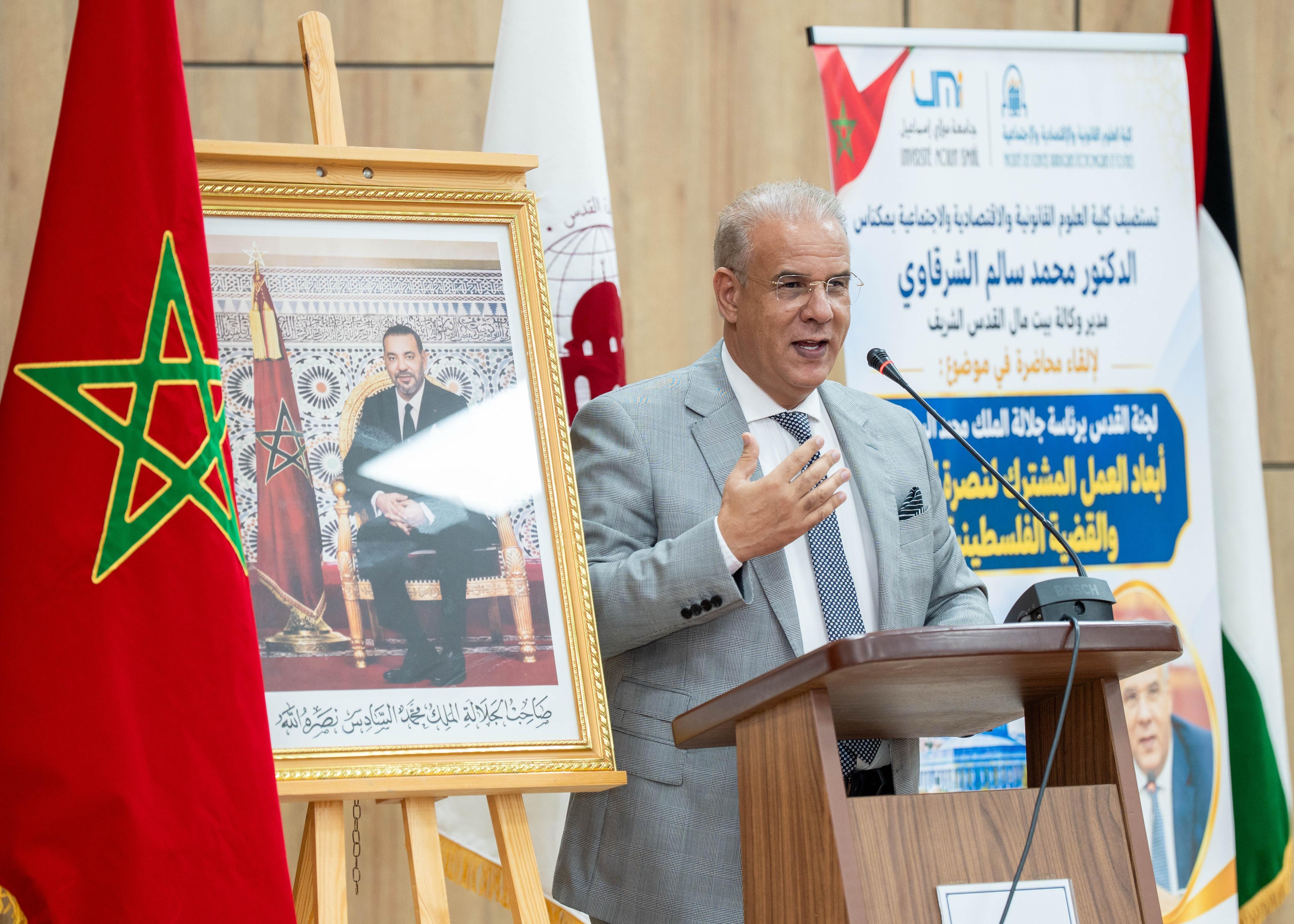
Meknes - Dr. Mohamed Salem Echarkaoui, Acting Director of Bayt Mal Al-Quds Asharif Agency (BMAQ), said on Thursday in Meknes that, under the chairmanship of His Majesty King Mohammed VI, the Al-Quds Committee plays a pivotal role in safeguarding the legal and historical status of the Holy City and coordinating political and legal efforts in support of the Palestinian cause. He noted that Morocco’s steadfast commitment to Jerusalem is deeply rooted in its longstanding historical ties with the city and finds practical expression in field initiatives designed to strengthen the resilience of its people and institutions.
He made these remarks during a lecture delivered at the Faculty of Legal, Economic and Social Sciences of Moulay Ismail University in Meknes, entitled “The Al-Quds Committee under the Chairmanship of HM King Mohammed VI: Dimensions of Joint Action in Support of Jerusalem and the Palestinian Cause”. The event was attended by the University President, Dr. Aboubakr Bouayad; the Dean of the Faculty, Dr. Mohammed Qaddous; faculty members; and university students.
Echarkaoui opened his lecture with an overview of the longstanding Moroccan presence in Jerusalem, tracing the historical ties between the Moroccan people and the Holy City back more than a thousand years. He highlighted the various forms these ties have taken over the centuries, from defending the city and settling there to religious life, the pursuit of knowledge and the contributions of Moroccan scholars to its intellectual and religious heritage.
He also drew attention to a number of Moroccan scholars and travellers whose lives and journeys were closely connected to Jerusalem, notably Abu Salim Al-Ayyashi, who resided in the city and chronicled his experiences in his travelogue Ma’ al-Mawa’id. He also highlighted the Moroccan presence during the Ismaili era, as documented in historical travelogues and biographical accounts, which provide valuable insight into the intellectual exchanges between Moroccan scholars and their counterparts in Jerusalem.
Highlighting the historical role played by Moroccans in supporting Salah al-Din al-Ayyubi, Echarkaoui recalled that Yaqub al-Mansur al-Muwahhidi dispatched a naval fleet to assist him in the conquest of Acre and his advance towards Jerusalem. He also recounted the story of Hajj Musa al-Rida, brother of Sheikh Abdessalam Ibn Mashish al-Alami, who joined Salah al-Din’s efforts and spent several years in Jerusalem before eventually returning to Morocco.
Echarkaoui stressed that these deep-rooted historical ties underpin Morocco’s enduring commitment to Jerusalem and the Palestinian cause, a commitment that has been sustained across religious, political and humanitarian dimensions and reinforced through institutional initiatives led by successive Moroccan monarchs.
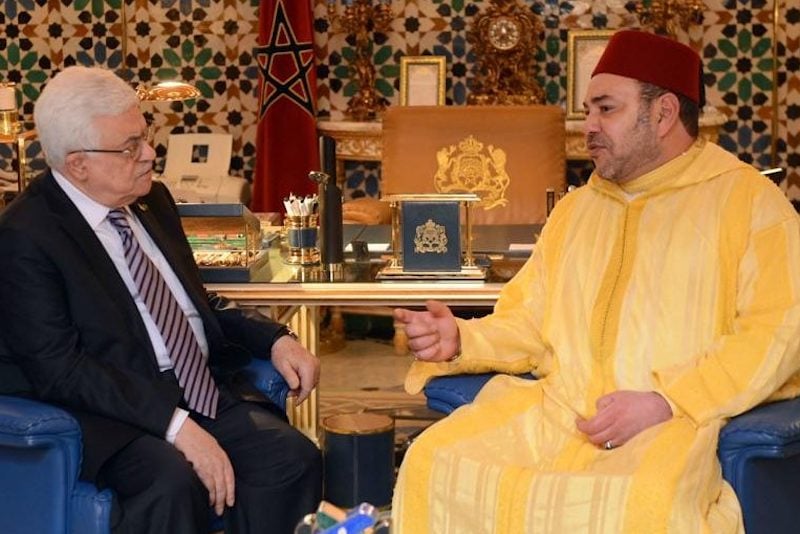
In this regard, he recalled the initiative taken by the late King Hassan II, following the attack on Al-Aqsa Mosque on 21 August 1969, to call for the establishment of the Organization of Islamic Cooperation (OIC). He subsequently spearheaded the creation of the Al-Quds Committee, which was approved at the OIC’s Sixth Conference of Foreign Ministers, held in Jeddah in 1975. Morocco was entrusted with the Committee’s chairmanship at the Organization’s Tenth Conference, held in Fez in 1979.
Echarkaoui recalled that, in 1995, King Hassan II initiated the establishment of Bayt Mal Al-Quds Asharif Agency (BMAQ) as the financial and operational arm of the Al-Quds Committee, mandated to address the needs of Palestinians in Jerusalem. He also oversaw the development of the Agency’s statutes and institutional framework, paving the way for it to begin operations in 1998.
He added that His Majesty King Mohammed VI continues this legacy as Chairman of the Al-Quds Committee, working to protect Jerusalem’s legal status and civilisational character, while reaffirming its significance as a city sacred to the three monotheistic religions. He also cited the “Al-Quds Call”, signed by His Majesty and Pope Francis in Rabat on 30 March 2019, which highlights the importance of preserving Jerusalem’s special status as a shared heritage of humanity and a place of peaceful coexistence among the followers of the three faiths.
Addressing Morocco’s position on the war in the Gaza Strip, Echarkaoui outlined six fundamental principles: securing an immediate and lasting ceasefire; protecting civilians; ensuring the delivery of sufficient humanitarian assistance; preserving and strengthening the role of the United Nations Relief and Works Agency for Palestine Refugees in the Near East (UNRWA); rejecting the forced displacement of Palestinians; and pursuing serious negotiations to revive the political process and advance a two-state solution.
He emphasised that the Agency’s work on the ground complements Morocco’s diplomatic efforts on the political and legal fronts, translating the vision of His Majesty King Mohammed VI into practical programmes that respond to the needs of Jerusalem’s residents. These interventions bring together humanitarian and social support, sustainable development, the economic empowerment of productive groups and institutional capacity-building.
Although the Agency was conceived as a mechanism for coordinating Arab and Islamic support for Jerusalem, it is funded entirely by the Kingdom of Morocco. Its annual budget amounts to approximately USD 7 million, including USD 3 million in operating expenses. Echarkaoui also highlighted the importance of Moroccan-Palestinian partnerships in carrying out the Agency’s programmes and projects.
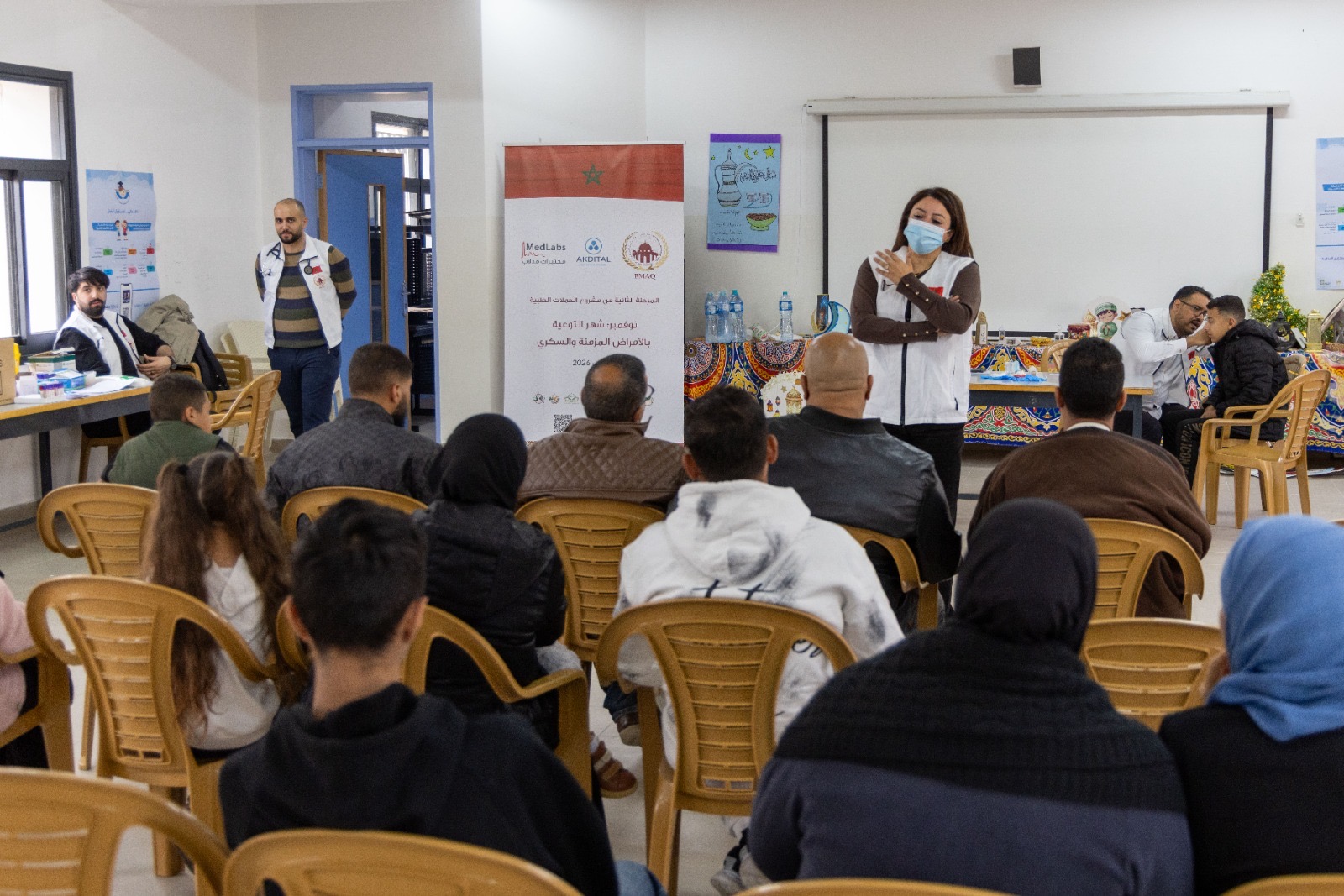
Echarkaoui went on to highlight the Agency’s key activities in 2026 across education, social assistance and healthcare. He reported that 400 students had benefited from its scholarship programme, while its university partnerships had expanded to four institutions. The Agency also provided Ramadan assistance to 5,000 families and continued its orphan sponsorship programme, supporting 500 orphans in Jerusalem and 350 in the Gaza Strip. In healthcare, its free medical campaigns reached approximately 3,000 people through 26 medical outreach days conducted across 33 locations in Jerusalem and its surrounding areas.
In the fields of economic empowerment and agricultural development, the Agency supported 34 Palestinian start-ups through its business incubator and helped six companies participate in GITEX Africa in Marrakech. It also provided training in import and export procedures to around 100 Jerusalem-based traders. On the agricultural front, the Agency launched the Awnacampaign, extending support to approximately 2,250 farmers across 20 locations in Jerusalem Governorate, alongside the Sumoud (Resilience) project, which benefited a further 250 farmers.
Through its programmes for children and young people, as well as its innovation initiatives, the Agency reached more than 3,000 children through summer activities in Jerusalem, while 50 took part in its summer camp in Morocco. It also organised the Al-Quds Hackathon 2026, which brought together more than 120 young people representing eight Palestinian universities.
Outlining the Agency’s priorities for the coming period, Echarkaoui noted that consultations had been held in Ramallah and Jerusalem to shape its 2027–2030 Action Plan. The plan aims to gradually move beyond direct assistance towards greater economic and social empowerment, while strengthening governance, advancing digital transformation and developing more effective impact assessment mechanisms.
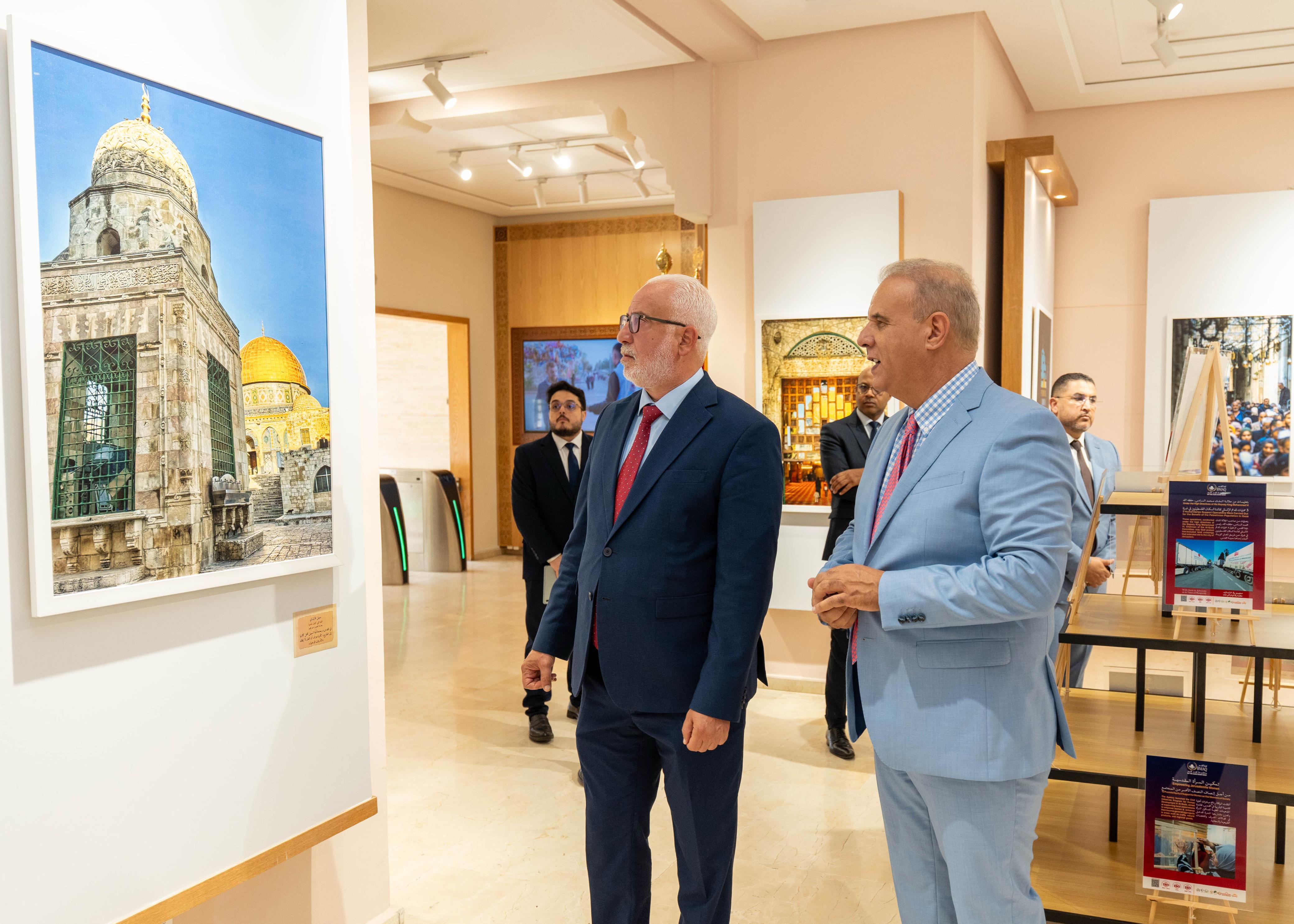
Alongside the lecture, BMAQ organised an exhibition showcasing its programmes and initiatives. Among the exhibits was Hayya, a platform designed for children and young people, featuring an animated series entitled The Five Keys of Jerusalem and interactive displays incorporating augmented reality and QR-code technology. These tools offer children an engaging introduction to Jerusalem’s history, religious and cultural landmarks, and people, while encouraging them to ask questions and explore the city’s heritage.